
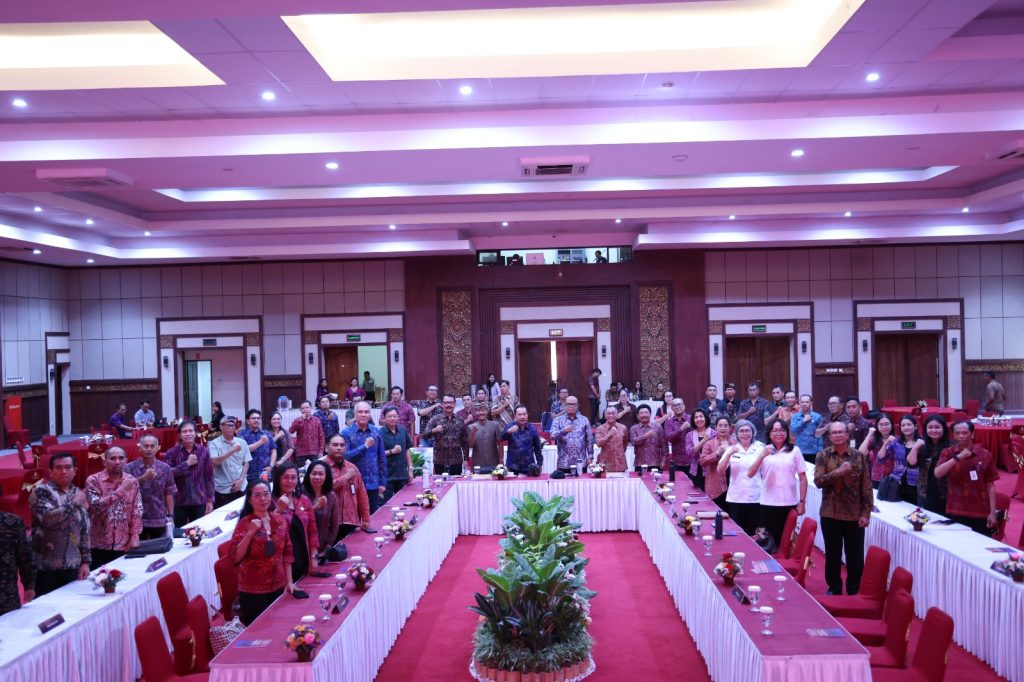
Photo: Focus Group Discussion (FGD) “Towards 100 Years of Balinese Tourism #2,” Wednesday (16 September), at the Kirtya Sabha Mahottama Auditorium, ISI BALI.
To further develop the preparation of the scholarly study 100 Years of Balinese Cultural Tourism, Institut Seni Indonesia Bali (ISI BALI) and the Regional Research and Innovation Agency (BRIDA) of Bali Province once again held a Focus Group Discussion (FGD) entitled “Towards 100 Years of Balinese Tourism #2” on Wednesday (16 September) at the Kirtya Sabha Mahottama Auditorium, ISI BALI. The event formed part of the ongoing effort to refine the scholarly study, which is scheduled for publication in 2027 to coincide with the centenary of the development of tourism in Bali.
The FGD carried the theme “Yukti-Jnana-Yatra,” interpreted as a voyage toward deeper knowledge, and served as a continuation of the first FGD held on 13 July 2026. The forum brought together academics, members of the Bali Provincial Development Expert Group for Culture and Tourism, tourism practitioners, cultural figures, and researchers to enrich the study through historical, academic, and practical perspectives.
The event was officially opened by Ni Luh Putu Seni Artini, S.E., Ak., M.Si., Secretary to the Head of BRIDA Bali Province. The forum featured three speakers representing diverse backgrounds in Bali’s tourism sector: AA Gde Rai, founder of the Agung Rai Museum of Art (ARMA); Ida Bagus Sidharta Putra, Chairperson of the Sanur Development Foundation; and I Gusti Agung Ngurah Rai Suryawijaya, Chairperson of the Indonesian Hotel and Restaurant Association (PHRI) Badung.
During the forum, the Rector of ISI BALI, Prof. Dr. Wayan ‘Kun’ Adnyana, presented research findings on the development of Balinese cultural tourism, mapped across five historical periods. These periods comprise the Formation of Tourism in Bali (1927–1945), the First Revival of Tourism in Bali (1945–1965), the Second Revival (1965–1996), the Third Revival (1997–2017), and the Fourth Revival (2018–present).
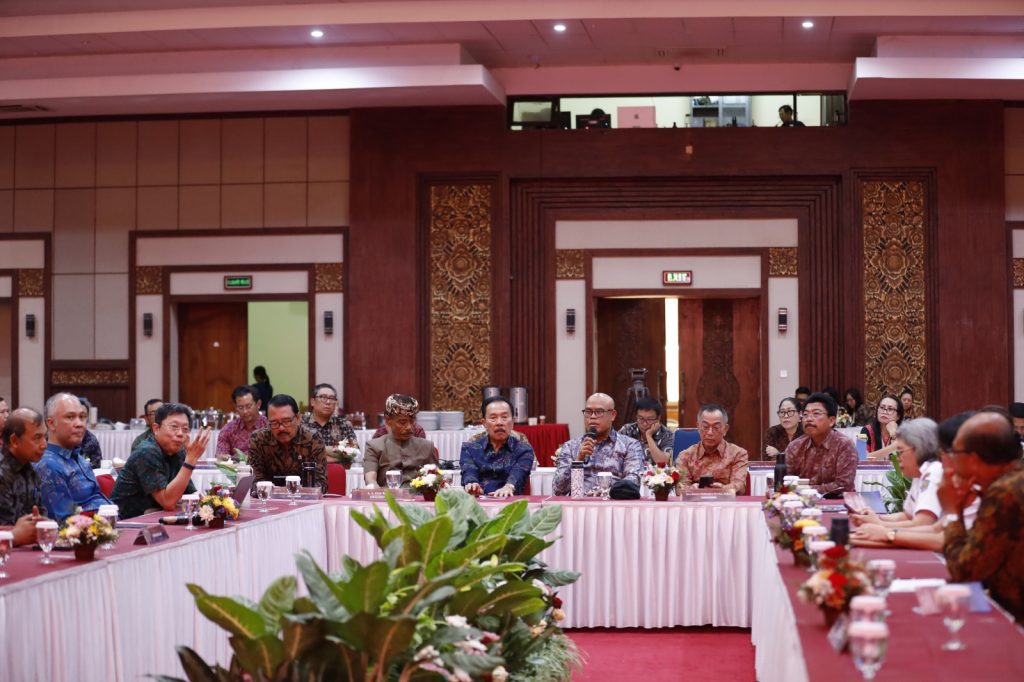
Photo: Focus Group Discussion (FGD) “Towards 100 Years of Balinese Tourism #2,” Wednesday (16 September), at the Kirtya Sabha Mahottama Auditorium, ISI BALI.
This historical mapping serves as one of the foundations for the preparation of the book, which is being developed by a 20-member research and writing team, including five professors. Through a series of FGDs, the team continues to refine the substance of the book to provide a more comprehensive account of the development of tourism in Bali while offering perspectives on its future trajectory.
Several strategic aspects were subsequently discussed by the speakers. AA Gde Rai presented a topic entitled “Museums as Institutions for the Preservation of Art and Culture and as Tourism Destinations,” highlighting the role of museums in cultural preservation as well as in the development of tourism attractions.
Meanwhile, Ida Bagus Sidharta Putra discussed “Sanur Area-Based Tourism Governance,” drawing on experiences in managing the Sanur area through community involvement. I Gusti Agung Ngurah Rai Suryawijaya presented “Destination Management and Balinese Hospitality Practices,” addressing the dynamics of destination management and contemporary challenges facing Bali’s tourism sector, including overtourism.
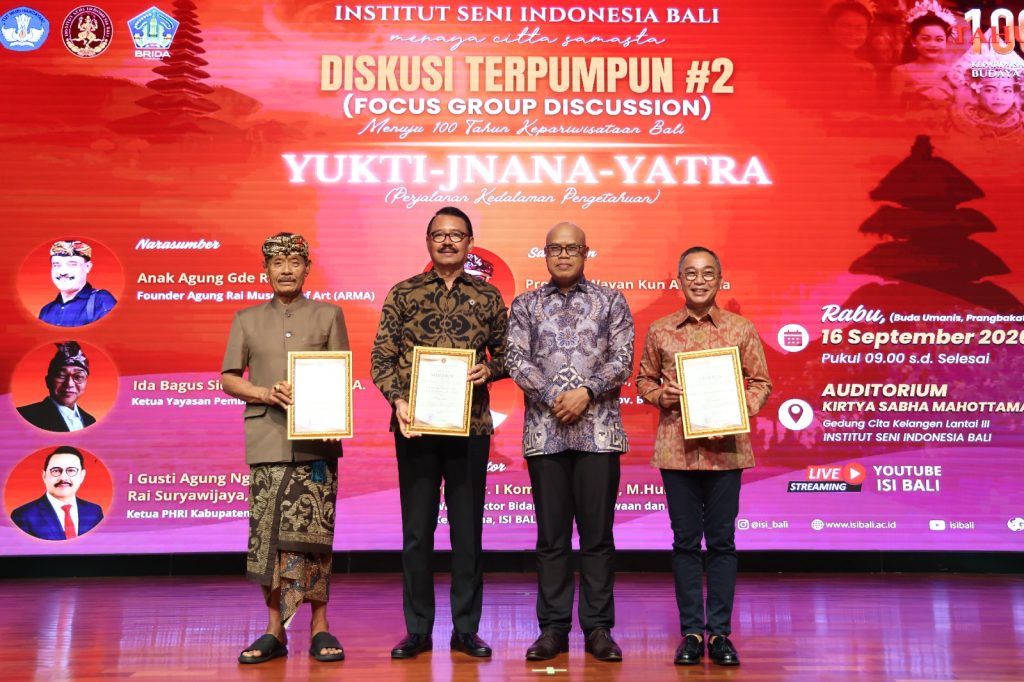
Photo: Presentation of Certificates of Appreciation to the speakers of the FGD “Towards 100 Years of Balinese Tourism #2,” Wednesday (16 September), at the Kirtya Sabha Mahottama Auditorium, ISI BALI.
The discussion also developed an understanding that tourism in Bali does not rely solely on culture as a tourism product, but encompasses a diverse range of activities and attractions that have evolved throughout the history of tourism development on the island.
Cipto Aji Gunawan, a member of the Bali Provincial Development Expert Group for Tourism, cited the development of marine tourism, particularly surfing and diving, as an important factor in shaping the character of tourism in Bali. According to him, these activities were initially introduced by international visitors and subsequently developed into important elements of Bali’s tourism identity. This perspective is considered important in understanding the development of tourism from a broader perspective, including the interaction between local communities and various external influences.
Additional input was provided by Ir. Made Gunaja, M.Si., a representative of the BRIDA Bali Province Quality Control Team. He emphasized the importance of documenting policy developments and government support throughout the history of tourism in Bali. According to him, the policies and contributions of Bali’s leaders, including governors serving during different periods, should be documented as part of an objective foundation for understanding the role of government in the development of tourism in Bali.
The various perspectives emerging from the FGD will subsequently serve as additional material for the writing team in refining the 100 Years of Balinese Tourism study. By integrating historical records, research findings, practitioners’ experiences, and policy perspectives, the book is expected to provide a comprehensive documentation of the century-long development of tourism in Bali.
(ISI BALI/Public Relations)


