Anti-corruption messages do not always have to be conveyed through formal campaigns. Through storytelling and illustration, comics serve as a creative medium to encourage the public to recognise the values of integrity while reflecting on various behaviours encountered in everyday life.
This approach was realised through a collaboration between students of the Indonesian Institute of the Arts (ISI) Bali and the Corruption Eradication Commission (KPK), through its Directorate of Educational Networks (Jardik), in the Sketch Your Integrity (SYI) 2026 comic competition. A total of 25 individual and group participants presented their ideas on integrity, transparency, and anti-corruption through illustrated storytelling.
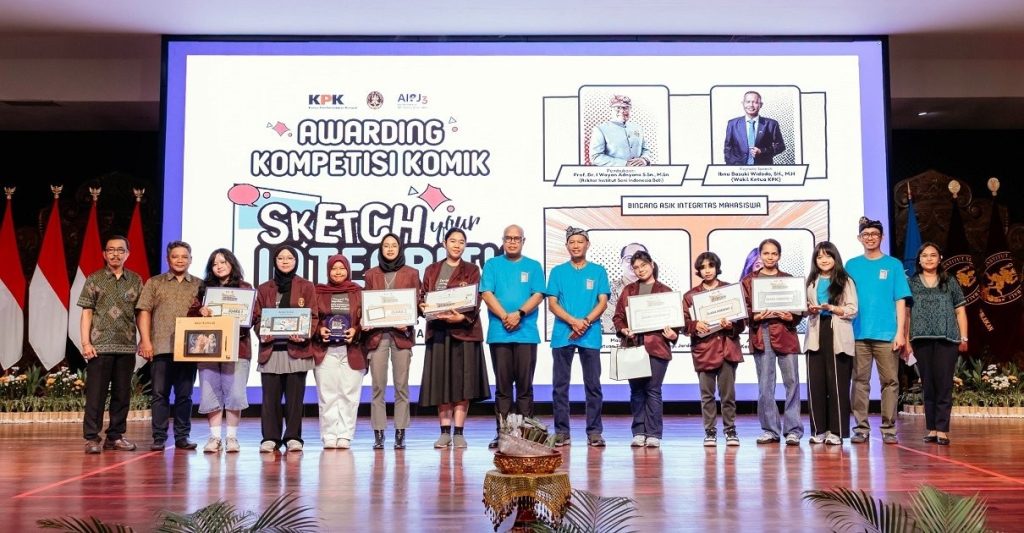
The competition culminated in an awarding ceremony held at the Citta Kelangen Building, ISI BALI Campus, on Tuesday (3 November), attended by approximately 200 students. In addition to recognising the works of the finalists, the event provided a platform for discussion on strengthening the role of art and student creativity in promoting anti-corruption values.
ISI BALI Rector, Prof. Dr. I Wayan ‘Kun’ Adnyana, expressed his appreciation for the collaboration with the KPK, which provided students with an opportunity to address issues of integrity through artistic creativity. He emphasised that art and design play a strategic role in interpreting various social phenomena. Comics, in particular, can communicate critical messages through a more accessible and engaging approach that resonates with the wider community.
“Comics offer a critical medium without losing their sense of humour,” Kun remarked.
He further explained that ISI BALI had established Civics and Anti-Corruption as compulsory courses across all study programmes. The collaboration with the KPK through the SYI competition is expected to continue developing as a platform for students to cultivate their creativity while strengthening their commitment to integrity.
A similar perspective was shared by professional comic artist Adelia Maghfira, who participated in the discussion session as part of the awarding ceremony. According to her, the strength of comics lies not only in their visual elements but, more importantly, in the stories and messages conveyed to readers.
“The first thing to consider is the story itself: its content, meaning, and how that story can be effectively communicated through comics,” Adelia explained.
Through this competition, students were encouraged to explore social phenomena and everyday experiences related to integrity. In this way, anti-corruption messages can be communicated through approaches that are more contextual and relevant to the lives of younger generations, without necessarily relying on formal language or conventional methods.
KPK Vice Chairperson Ibnu Basuki Widodo stated that corruption eradication is not limited to law enforcement but also encompasses prevention, education, and public participation. In the context of higher education students, these three approaches can be realised through various activities aligned with their interests and creative capacities.
“The eradication of corruption is carried out through prevention, education, law enforcement, and public participation. What the KPK and ISI BALI are currently undertaking is part of education and student participation in the broader effort to eradicate corruption,” Ibnu stated.
He emphasised that students occupy an important position as a moral force, a form of social oversight, and agents of change. Therefore, student involvement in the anti-corruption movement does not necessarily have to take formal forms but can also be expressed through various creative works capable of inspiring society.
“The KPK’s hope for students, as the pillars of the future, is that they will serve as a moral force, a means of social oversight, and agents of change. As agents of change, they are expected to drive transformation. Through comic works, we hope they can also bring about positive change through inspiring stories,” Ibnu added.
Meanwhile, Head of the Higher Education Task Force at the KPK Directorate of Educational Networks, Masagung Dewanto, explained that anti-corruption education is intended to foster experiences and habitual practices of integrity, enabling these values to become embedded in individual behaviour. Accordingly, students need opportunities to apply integrity in various activities, both within the campus environment and in their everyday lives.
“It is important to provide students, as the primary target of anti-corruption education, with opportunities to experience and develop habitual practices of integrity,” Masagung stated during the talk show entitled Bincang Asik Integritas Mahasiswa (An Engaging Discussion on Student Integrity), which formed part of the awarding ceremony.
According to Masagung, participation in the anti-corruption movement can be pursued in accordance with each individual’s capacity and passion. Students can begin within their immediate surroundings, including by cultivating honesty in everyday activities, such as refraining from cheating and plagiarism.
“Efforts to advocate for anti-corruption do not necessarily have to involve reporting cases to law enforcement authorities. They can be undertaken according to each individual’s passion, starting with the issues closest to them, such as cheating and plagiarism. Advocating through comics is also an alternative way of expressing an anti-corruption stance,” he explained.
He added that the SYI competition represents a form of co-curricular activity that can support the implementation of Anti-Corruption Education in higher education institutions. Beyond the formal curriculum, anti-corruption education needs to be reinforced through various activities that provide students with opportunities to practise and internalise the values of integrity.
“Although educational strategies may take a considerable amount of time to produce their impact, their outcomes tend to be more enduring. Put simply, the objective is to create a society in which people no longer even consider engaging in corruption. In the terminology of the United Nations Convention against Corruption (UNCAC), this means fostering a society that is no longer permissive of corruption,” Masagung remarked.
Six works were selected as winners of the competition. First prize was awarded to Putu Anggi Ramania for her work entitled Semua Juga Begitu. Second prize went to the Triple T Group, comprising Alicia Evrilliana Sandy, Jashmine Alya, and Raisa Salsabila, for their work entitled Dibalik Pameran.
Third prize was awarded to Ni Putu Prillavenia Yogiputri for her work entitled Sedikit Saja. First Honourable Mention went to the Untitled Group, comprising Fransiska Kathleen Paula Gus, Gracia Putri Amelia Sinaga, and Neisya Azzhra, for their work entitled Kupon Kok Wajib?. Second Honourable Mention was awarded to Ni Putu Sudharsih for her work entitled Eraser, while Third Honourable Mention went to the Lomba Komik Group, comprising Nethania Ayuningtyas Hillary Ussu, Winny Risdawati, and Lutgarde Ranera Silaen, for their work entitled Sesuap Nasi.
The KPK hopes that collaboration with higher education institutions through various creative approaches will continue to grow. Students are expected not only to be recipients of anti-corruption education but also to take an active role as part of a broader ecosystem that advocates for and cultivates a culture of integrity within society.
The SYI 2026 competition at ISI BALI was organised with the support of the Australia-Indonesia Partnership for Justice Phase 3 (AIPJ3). The event formed part of the broader SYI competition series conducted at three higher education institutions: the Kalimantan Institute of Technology (ITK), ISI BALI, and ISI Surakarta.


