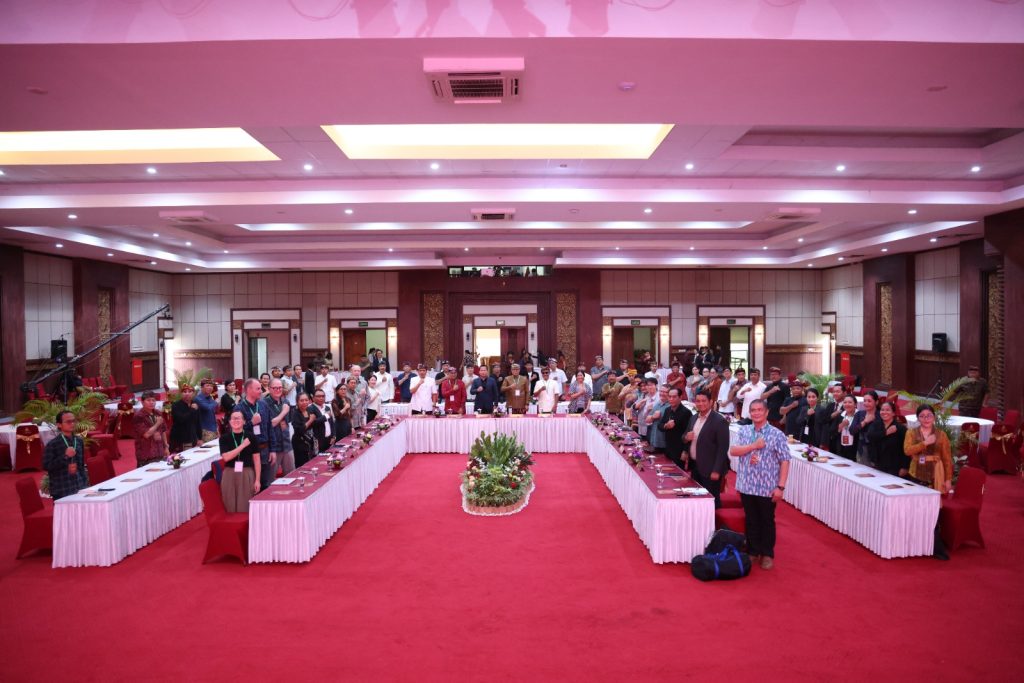
Photo: Bali-Global Arts and Design Symposium (B-GADS) 2026 at the Kirtya Sabha Mahottama Auditorium, ISI BALI, Thursday, October 29, 2026.
The Leader Summit, held as part of B-GAAD III 2026 on Tuesday, October 27, 2026, at the Sabha Citta Mahottama Room, Desain Hub Building, ISI BALI, brought together 12 leaders or representatives of arts and design higher education institutions from across the Asia-Pacific region, along with 18 members of ISI BALI’s leadership team. Conducted in a warm and enthusiastic atmosphere, the summit facilitated the exchange of diverse perspectives and culminated in the formulation of Bali’s Perspectives, an articulation of the five B-GAAD visions known as Panca Mahadharma:
- Holistic Arts and Design Education and Academic MobilityHigher education in arts and design constitutes a holistic learning process that integrates knowledge, experience, and creative capacity. Mobility initiatives in various forms, including double-degree programs connecting students and lecturers in arts and design with diverse local cultures, artistic and design environments, and transnational networks across the Asia-Pacific region, are fundamental. Such mobility programs serve as strategic instruments for strengthening the quality and reputation of arts and design education in the contemporary era.
- Human Creativity and Innovation in the Age of Artificial IntelligenceArtistic and design creativity and innovation must position artists and designers as the principal creators. The engagement of the hands and spirit must remain essential elements of the creative process. Artificial intelligence (AI) and other advanced technologies should continue to serve as creative instruments. Their application must be guided by wisdom and responsibility, ensuring that the primacy of artistic creation remains connected to the creator’s spirit and cultural meaning.
- Arts and Design as Expressions for Society and Local Cultural AppreciationFundamentally, arts and design are created for society. We fully recognize that local culture constitutes a primary source of creativity and an open source of inspiration for diverse forms of further development. Such developments must always be undertaken with the highest respect for the existing local cultures and their inherent values.
- Arts and Design Research and Creation for Environmental ConservationThe relevance of artistic and design creation and research to the conservation of the natural environment requires synergy with scientific research. The distinctive value of artistic and design practices and research lies in their capacity to raise questions and offer new perspectives emerging from imagination and the creative spirit. Their contribution to fostering global solidarity and collective concern for nature creates opportunities for a more diverse and sustainable future.
- B-GAAD as a Strategic Platform for Regional CollaborationB-GAAD is envisioned as a strategic platform and meeting ground for the exchange of ideas among arts and design higher education institutions throughout the Asia-Pacific region. This platform is dedicated to bridging tradition and innovation, as well as technology and the human spirit, in pursuit of greater societal well-being.
The principles outlined in Bali’s Perspectives were further reflected in the Bali-Global Arts and Design Symposium (B-GADS). All keynote and invited speakers presented field-based data and analytical perspectives, addressing themes that had also emerged during discussions on the formulation of Bali’s Perspectives at the B-GAAD’s Leader Summit.
B-GADS featured 18 selected speakers, with two keynote speakers providing the principal intellectual impetus: President of Phetchaburi Rajabhat University, Thailand, Assoc. Prof. Dr. Phatcharasak Arlai, and Rector of ISI BALI, Prof. Dr. Wayan ‘Kun’ Adnyana. The symposium was held on Thursday, October 29, 2026, at the Kirtya Sabha Mahottama Auditorium.
The other invited speakers included Professor Ye Eun Lee (Dongduk Women’s University) and Professor Min Seol (Sungkyunkwan University), South Korea; Prof. Jaygo Bloom (LASALLE College of the Arts), Singapore; Prof. Jeremy Grimshaw (Brigham Young University), United States; Assoc. Prof. Suzlee Ibrahim (National Academy of Arts, Culture and Heritage – ASWARA), Prof. Azril Ismail (School of Postgraduate Studies, UCYP University), and Ts. Dr. Ellyana Mohd Muslim Tan (Universiti Teknologi MARA – UiTM), Malaysia; Prof. Justin DeHart (University of Canterbury), New Zealand; Prof. Masaru Nakamoto (Okinawa Prefectural University of Arts – OPUA), Japan; and Prof. Ying-fen Wang (Graduate Institute of Musicology, National Taiwan University), Taiwan.
Representing Bali and Indonesia were Anak Agung Gde Rai, Founder of the Agung Rai Museum of Art (ARMA), and Pande Made Amarysti Kardi, B.Sc., General Affairs representative of the Neka Art Museum (NAM). The ISI BALI delegation comprised Dr. Made Kartawan, Dr. Anak Agung Ngurah Anom Mayun Konta Tenaya, Dr. Ida Ayu Wayan Arya Satyani, and Dr. Made Jodog.


