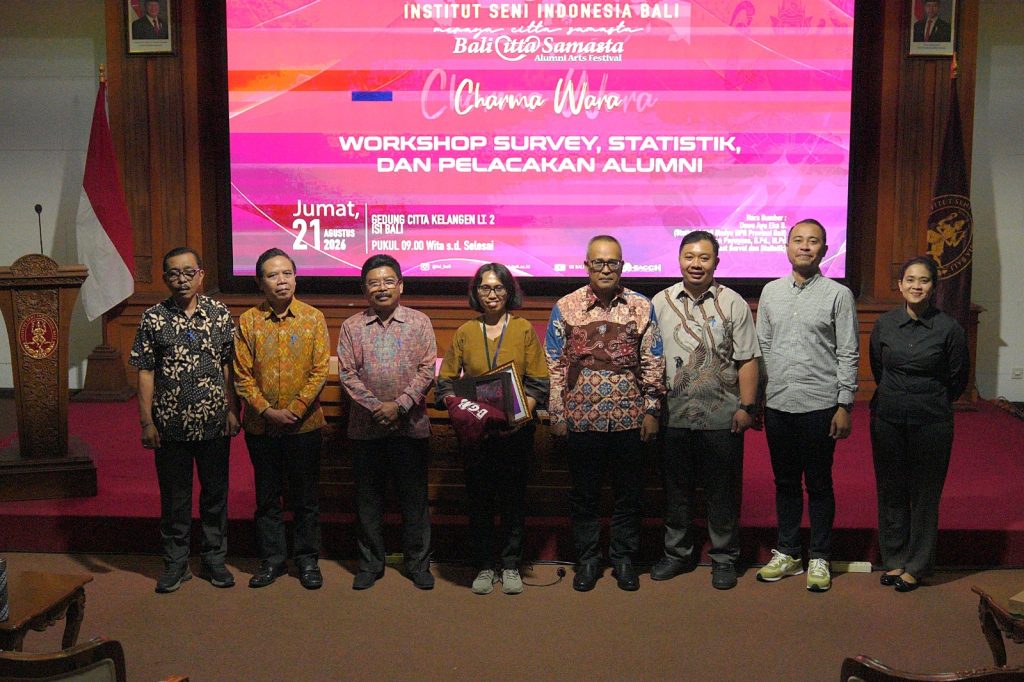
Photo: Workshop on Alumni Survey, Statistics, and Tracer Study at the Vicon Room, ISI Bali, Friday, 21 August 2026.
The Institut Seni Indonesia Bali (ISI Bali) organized a Workshop on Alumni Survey, Statistics, and Tracer Study as part of the 2026 Bali Citta Samasta Program (Alumni Arts Festival). The workshop was held at the Vicon Room of ISI Bali on Friday, 21 August 2026, and was attended by members of the university leadership, study program coordinators, and the survey team.
The workshop was opened by the Vice Rector for Academic Affairs and Information Systems of ISI Bali, Prof. Dr. AA Gde Bagus Udayana. The event featured Dewa Ayu Eka Sumarningsih, SST, SAB, M.Stat., Associate Expert Statistician at the Bali Provincial Statistics Indonesia (BPS) Office, together with I Nyoman Payu Yasa, S.Pd., M.Pd., Head of the Center for Survey and Statistics at ISI Bali, and I Gede Indra Suwija Putra, S.H., Head of the General Affairs Division of LPMPP ISI Bali, as resource persons.
In his report, the Head of the Institute for Quality Assurance and Learning Development (LPMPP) of ISI Bali, Prof. Dr. I Wayan Setem, explained that Bali Citta Samasta represents one of the initiatives through which ISI Bali implements its institutional mission under the Astha Mahacitta Bali framework. Its implementation refers to Article 4 of Minister of Higher Education, Science, and Technology Regulation No. 50 of 2025 concerning the Statutes of the Institut Seni Indonesia Bali, as well as regulations governing alumni tracking or tracer studies within ISI Bali.
According to Prof. Setem, Bali Citta Samasta is designed as a platform for interaction and collaboration between ISI Bali and its alumni. Through this program, the university seeks not only to establish and strengthen networks with its graduates but also to enhance its alumni data collection and tracking system as an important component in measuring higher education outcomes.
“The implementation of Bali Citta Samasta aims to provide a platform for interaction and collaboration between ISI Bali and its alumni, ultimately contributing to the achievement of Key Performance Indicator (IKU) 2,” said Prof. I Wayan Setem.
IKU 2 relates to the percentage of higher education graduates who, within one year after graduation, are employed, become entrepreneurs, or continue their studies, including graduates who were already employed or engaged in entrepreneurial activities before completing their education. Accordingly, accurate alumni data and the effective implementation of tracer studies are essential to ensuring that the achievement of this indicator can be measured properly.
Furthermore, Bali Citta Samasta is expected to contribute to the preparation of the Higher Education Social, Economic, and Environmental Impact Indicator Fulfillment Report within the framework of the Ministry of Higher Education, Science, and Technology. Such contributions include social impacts generated through inclusive and affirmative education, as well as economic impacts associated with the economic contributions of students and members of the public who attend or visit higher education institutions and participate in university-organized activities.
In addition, the program is intended to strengthen the university’s entrepreneurial ecosystem, including spin-offs and start-ups that receive support or facilitation from higher education institutions. Alumni engagement is therefore expected to extend beyond post-graduation relationships and develop into a broader network that generates meaningful impacts for the institution, alumni, society, and the economy.
In his remarks, Prof. Dr. AA Gde Bagus Udayana emphasized the importance of accurate data management as a foundation for academic policymaking and institutional development. He expressed his hope that the workshop would enhance the capacity of survey teams and study programs to systematically collect, process, analyze, and utilize alumni data.
He also encouraged the university to ensure that alumni tracking is not viewed merely as an administrative obligation for fulfilling performance indicators, but rather as a strategic institutional instrument for assessing the relevance of academic programs to labor-market needs, monitoring graduates’ career development, and understanding the contributions of alumni to society.
Through this workshop, ISI Bali is expected to further develop an integrated, accurate, and sustainable alumni survey and tracer study system. The resulting data will serve as an important foundation for improving the quality of learning, strengthening engagement with alumni, and reinforcing ISI Bali’s position as an impact-oriented university that delivers tangible benefits to society.
(ISI Bali/Public Relations)


