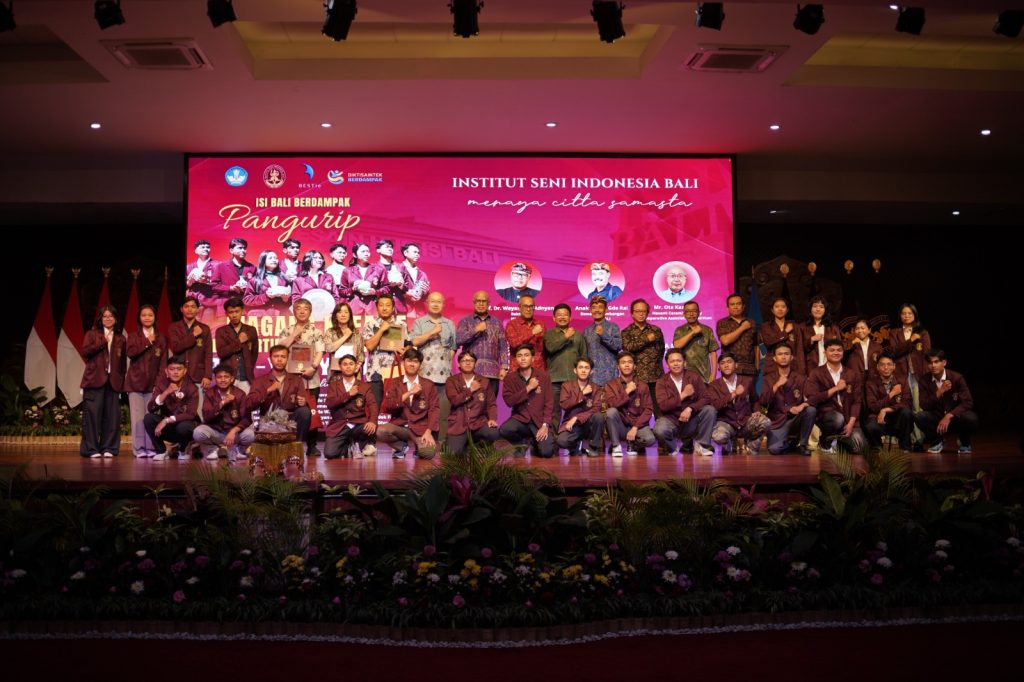
Photo: Inauguration of the Internationally Certified Creative Internship Program JANA-WIDYA-JNANA at the Kirtya Sabha Mahottama Ballroom, 3rd Floor, Citta Kelangen Building, ISI BALI, Tuesday (1/9).
The Indonesian Institute of the Arts Bali (ISI BALI) officially launched the JANA-WIDYA-JNANA Internationally Certified Creative Internship Program (Noble Global Talent) through an inauguration ceremony held on Tuesday, September 1, 2026, at the Kirtya Sabha Mahottama Ballroom, 3rd Floor, Citta Kelangen Building, ISI BALI. The ceremony was attended by Rector of ISI BALI, Prof. Dr. Wayan ‘Kun’ Adnyana, together with the entire leadership of ISI BALI; Chairman of the Hasami Ceramic Industry Cooperative Association, Mr. Ota Kazuhiko; Deputy Director of the Ceramic Research Center of Nagasaki, Mr. Hideki Yoshida; representative of BESTie CO., Ltd., Ms. Misako Masuzumi; staff member of the Hasami Ceramic Industry Cooperative Association, Mr. Hirotoshi Yamada; as well as members of the ISI BALI Advisory Board, AA Gde Rai and Warih Wisatsana.
A total of 25 seventh-semester students from the Study Programs of Craft Arts, Fine Arts, and Product Design were selected to participate in the program following a selection process conducted by ISI BALI in collaboration with Japanese ceramic industry partners. The selected participants are I Gusti Ayu Wijayanti P., Ida Made Gaodya Rendraswara, I Dewa Bagus Wahyu, I Wayan Aria Santosa, Rayna Najla K., I Wayan Aria Sisya N., Martha, I Made Sofyan, Zefanya Awan B., Ni Wayan Arianti Dewi, Arwen Jennifer P., Ni Luh Dewi Kusuma W., I Komang Aryawan, Cokorda Gede Raka Wisma W., Ni Luh Putu Karina Praba D., I Putu Ranu Weda W., I Kadek Agus Adi W., I Kadek Sudana, Ni Kadek Karini A., Adi Purnama Yoga, I Wayan Adi Wiryatama, I Kadek Fajar N., Alfridus Moensaku, I Kadek Calvin Y., and I Gst. Ngurah Putu Diva.
Through this program, participants will undertake intensive training at ISI BALI as a preparatory stage before entering the professional industrial environment. The training includes Japanese language instruction, Hasami ceramic techniques, ceramic production technology, 3D product design, and other relevant competencies. The training is expected not only to enhance students’ technical skills but also to strengthen their communication abilities, cultural adaptability, discipline, and readiness to work within professional and internationally oriented industrial environments.
Upon completion of the training program and evaluation process, eight outstanding participants will be selected to undertake an international internship in Hasami, Nagasaki Prefecture, Japan. Hasami is recognized as one of Japan’s important ceramic production centers. Accordingly, internship experience in the region is expected to broaden students’ understanding of production processes, design innovation, workplace culture, and developments within the Japanese ceramic industry.
Meanwhile, the remaining 17 participants will undertake internships with reputable domestic craft-art industry partners in Indonesia. Through this scheme, all participating students will have the opportunity to apply their academic competencies in professional contexts, whether through industrial experience in Japan or Indonesia.
Rector of ISI BALI, Prof. Dr. Wayan ‘Kun’ Adnyana, emphasized the importance of providing learning experiences that extend beyond the classroom. Through internship programs directly connected with industry, students are encouraged to understand professional work standards, develop their creative capacities, and establish professional networks that can support their career development after completing their studies.
Chairman of the Hasami Ceramic Industry Cooperative Association, Mr. Ota Kazuhiko, expressed his congratulations to the 25 students selected to participate in the JANA-WIDYA-JNANA Internationally Certified Creative Internship Program. He explained that participants would receive various forms of training and preparation prior to entering the industrial environment, including Japanese language instruction, 3D CAD, as well as knowledge and skills in design product development. According to him, language proficiency is an important component of students’ preparation before undertaking internship experiences, particularly for those who will have the opportunity to participate in the program in Japan. “I hope the students will learn Japanese well,” he said.
Through a comprehensive process encompassing training, selection, and internship implementation, the program is expected to cultivate talented individuals in the fields of art and design who possess not only strong creative competencies but also the capacity to adapt to industry requirements, a global perspective, and the ability to bring Indonesian artistic and design competencies into the international professional arena.