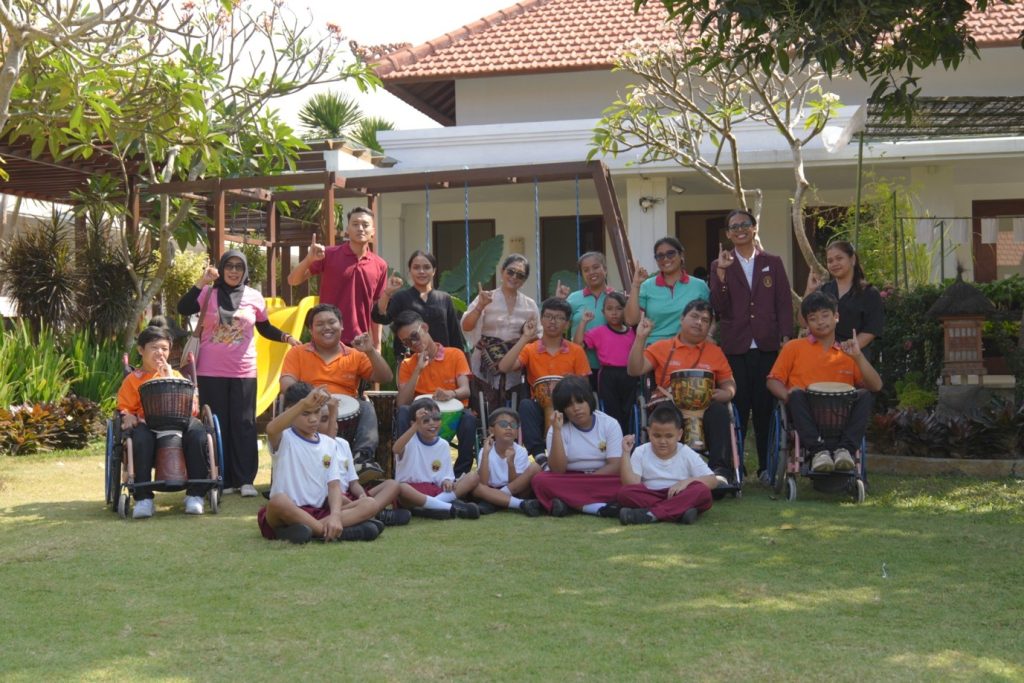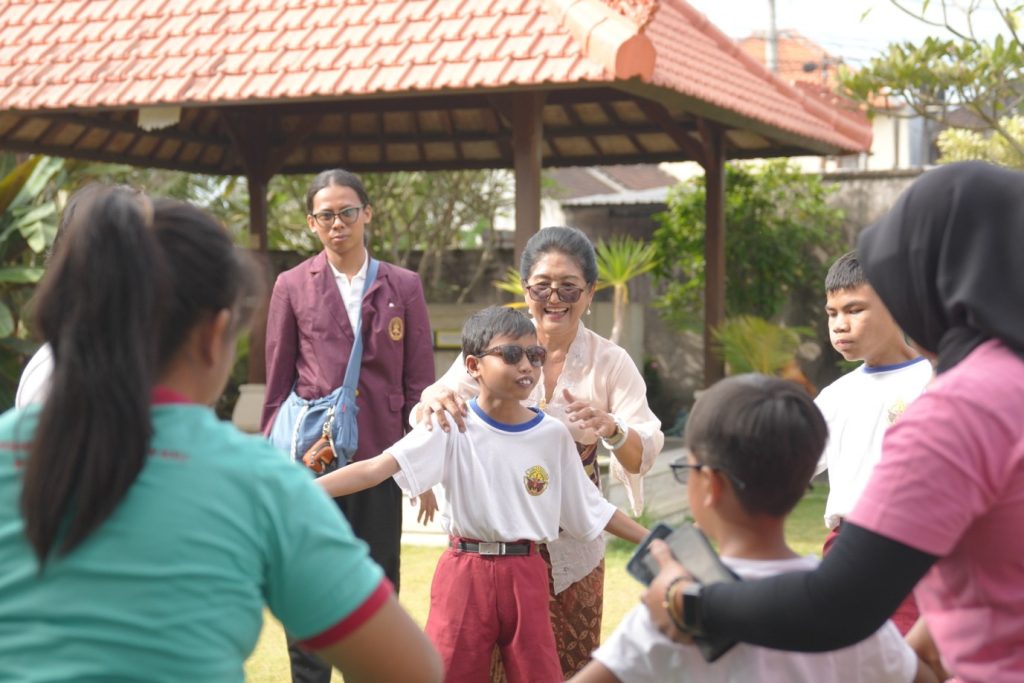
DENPASAR – Traditional Balinese games are not merely part of the region’s cultural heritage; they also hold significant potential as sources of arts education involving the body, sound, rhythm, touch, and social interaction. This potential is being developed through the program “Ngenkebang Batu: The Creation of an Intermedia Dance Based on Traditional Balinese Games as a Medium for Enhancing Sensory Awareness and Cultural Consciousness among People with Visual Impairments.”
The community engagement program, implemented in Penatih Dangin Puri Village, East Denpasar District, Denpasar City, introduces a more inclusive approach to dance by positioning people with visual impairments as active participants in the creative process and artistic experience. The program is conducted in collaboration with Kukuruyuk Art Studio (Sanggar Seni Kukuruyuk), an arts organization actively engaged in the development of traditional games and Balinese cultural activities. Through this collaboration, the traditional Balinese game ngenkebang batu is developed as a source of inspiration for an intermedia dance work that emphasizes non-visual experiences.
Unlike conventional dance education, which generally relies heavily on the visual observation of movement, the Ngenkebang Batu program develops artistic experiences through sound, touch, rhythm, bodily movement, spatial awareness, and interaction among participants. This approach creates opportunities for people with visual impairments not only to appreciate the arts but also to participate directly in the creative process.
Traditional games were selected because of their close relationship with the social life of the community. Such games involve physical movement, rhythmic responses, auditory cues, spatial awareness, communication, and interaction with others. These elements are subsequently translated into the process of creating intermedia dance.
“Through Ngenkebang Batu, we seek to demonstrate that dance does not necessarily have to originate from visual experience. The body, sound, touch, rhythm, and space can also serve as sources of knowledge and artistic experience,” the program team explained.
Connecting Tradition and Inclusive Art
The program emerged from concerns regarding the limited opportunities for people with visual impairments to participate in dance practices. Dance education and appreciation have traditionally relied on visual approaches, creating a need for methods that are more responsive to non-visual sensory experiences.
This condition highlights the importance of developing artistic practices that are not solely oriented toward preserving traditional forms but can also expand the role of art as a space for equitable social participation. Through traditional Balinese games, the program seeks to bring together two important objectives: cultural preservation and the development of inclusive artistic practices.
The ngenkebang batu game is therefore not treated merely as a cultural artifact that must be preserved, but as a source of creative ideas that can be transformed into new artistic experiences. In this way, values embedded in the game—including togetherness, environmental awareness, bodily coordination, rhythm, and social interaction—can be reinterpreted in forms that remain relevant to contemporary community needs.
The Art Studio as a Space for Exploration
The selection of Penatih Dangin Puri Village as the program site was based on several considerations. The area maintains strong connections with the social and cultural activities of Balinese communities. The presence of banjar communities, residential environments, communal activities, and various artistic and cultural practices means that the art studio does not function as an isolated artistic space but remains closely connected to the community.
Within the program, Kukuruyuk Art Studio serves as the primary partner and venue for various activities. The studio’s experience in developing traditional games provides an important foundation for the artistic creation process.
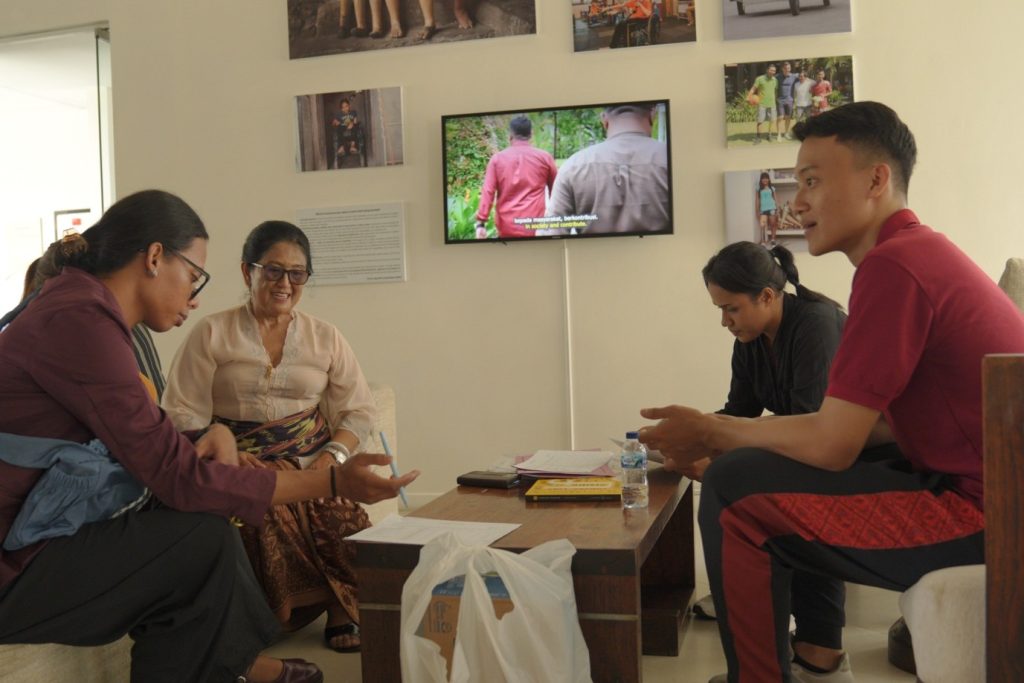
The program began in May 2026 with coordination and program alignment with the partner, accompanied by an introduction to the concepts of inclusive art and traditional games.
From June to August 2026, the activities progressed through several stages, including intermedia dance choreography training, sensory support and spatial arrangement training, digital documentation and publication training, collaborative dance creation, and the development of a sensory-responsive studio environment. These activities were designed to ensure that the creative process would not merely produce a dance work but also foster new skills and experiences among participants and partners.
Promoting Equitable Cultural Participation
Through this approach, Ngenkebang Batu aims to develop a model of intermedia dance creation capable of enhancing sensory awareness and cultural consciousness among people with visual impairments.
Participants are not positioned merely as passive beneficiaries but as integral contributors to the creative process. They are provided with opportunities to explore movement, sound, rhythm, space, and interaction, allowing artistic experiences to be developed according to their individual bodily abilities and experiences.
The program also seeks to broaden the meaning of cultural preservation. Culture is preserved not only by maintaining traditional forms but also by ensuring that diverse groups within society have opportunities to learn about, experience, and participate in cultural practices.
This approach is aligned with the spirit of the Sustainable Development Goals (SDGs), particularly SDG 4 on quality and inclusive education and SDG 10 on reducing inequalities. The program also supports Asta Cita, Point 4, particularly in strengthening human resources through inclusive and equitable education.
Supported by BIMA of the Ministry of Higher Education, Science, and Technology through PISN
The implementation of Ngenkebang Batu has been supported by BIMA of the Ministry of Higher Education, Science, and Technology (Kemendiktisaintek) through the Nusantara Arts Innovation Program (PISN). This support has played an important role in facilitating the development of the program, from partner coordination, training, and artistic exploration to the creation of the artistic work and the development of a studio environment that is more responsive to participants’ sensory needs.
The implementation team consists of Prof. Dr. Ida Ayu Trisnawati, SST., M.Si., as Principal Investigator, with Dr. I Gusti Putu Sudarta, SSP., M.Sn., and Ida Bagus Ketut Trinawindu, S.Sn., M.Erg., as team members. The team expressed its appreciation and gratitude to BIMA of the Ministry of Higher Education, Science, and Technology through the Nusantara Arts Innovation Program (PISN) for its support, which enabled the Ngenkebang Batu program to be implemented successfully.
“We would like to express our gratitude to BIMA of the Ministry of Higher Education, Science, and Technology through the Nusantara Arts Innovation Program (PISN) for its support of this program. This support has been invaluable in facilitating the creative process, training activities, and development of inclusive arts practices rooted in Balinese local culture.”
The Ngenkebang Batu program is expected to extend beyond a single community engagement initiative and serve as an initial step toward developing inclusive artistic practices rooted in local cultural heritage. Through the integration of traditional games, intermedia dance, and a multisensory approach, the program demonstrates that cultural heritage can remain dynamic and relevant by creating broader opportunities for participation across society, including people with visual impairments.